Week 8 for the STRENGTH Approach to Christian Wellness is H = Hold onto the Holy Spirit as He Guides You in the Change Process.
Well, if you’re reading this today you made it to week 8 of the STRENGTH Approach to Christian Wellness with me! H stands for hold onto the Holy Spirit as He guides you in the change process! I don’t know about you, but I find myself failing daily and hanging onto the promises of scripture as my Helper and Counselor guides me.
He reminds me gently in my spirit to think twice, be softer in my words, love like the Father and the Son love, and show grace. The more I fill my mind with God’s Word, the easier it is to submit my will to Him. I hang onto the Holy Spirit as those times of heated emotion emerge too. In the bible, I learn:
“My flesh and my heart may fail, but God is the strength of my heart my portion forever”
Psalm 73:26
The helpful words found in His life-giving book are just what I need when dealing with areas of strong emotion and habitual behavior. Especially when the temptation to lash out, allow fear to take over, or lose self-control when eating is present and persistent.
Scripture memory is so vital in this process because the Living God is speaking to me through His living Word!
““For the word of God is living and active, sharper than any two-edged sword, piercing to the division of soul and of spirit, of joints and of marrow, and discerning the thoughts and intentions of the heart.”
Hebrews 4:12
God, in the form of his Holy Spirit, is for me and you and not against us! He wants each of us to be whole in mind and body so we can live the abundant life Jesus calls us to live. I love how John Owen describes the Holy Spirit in a compilation of his work titled, “The Holy Spirit, His Gifts and Power”, he says:
“So, it is said of God, ‘God is a Spirit’ (John 4:24) his is a pure, spiritual, immaterial nature; not confined to a place, nor regarding one more than another in his worship. The reference of the Third Person of the trinity, as ascribed to him, declares his special manner and order of existence; so that wherever the Holy Spirit is mentioned, his relation to the Father and Son is included, for he is the Spirit of God. Herein there is an allusion to the breath of man; for as the vital breath of man has a continual emanation from him, and yet is never so utterly separated from his person, as to forsake him, so the Spirit of the Father and the Son proceeded from them by a continual divine emanation, still abiding with them.”
(Christian Heritage Imprint, 2004)
On a personal and spiritual level, as a believer and follower of the Lord Jesus, I take this to mean that the Holy Spirit is as much a part of me as my own breath.
Also, when I think of all the times I try to breathe in anxious moments, rising tempers, during exertion and activities, or when raising my voice to be heard among screaming kids….I NEED MORE of it.
Therefore, the same is true of the Holy Spirit, I need more of Him in those same moments.
So, how do you and I hold onto the Holy Spirit in these situations?
We take a super deep breath as we say, “Lord God, please take every thought captive to obey Christ (2 Cor. 10:5)
We hold tightly to the apostle Paul’s teaching before taking every thought captive: He says, “For though we walk in the flesh, we are not waging war according to the flesh but have divine power to destroy strongholds. That divine power is Jesus’ extended presence in the Holy Spirt. We understand we have no power, but God in us, DOES have great power!
Recognize the event causing turmoil and breathe through the emotions it evokes. At the same time accept the presence of the Holy Spirit with confidence and submit to Him the emotions, while processing the situation, being very specific in prayer as to what you need help doing as related to the following:
Controlling Fear/Anxiety/Anger/Depression
Battling the temptation to gossip/complain/criticize/argue with others
Overcome hurtful words, disrespect, sadness of a fallen world, laziness, or apathy
Honor the body (the tent of the Holy Spirit) by resisting addictive substances of sugar, alcohol, tobacco products, processed foods, or the temptation to overeat. Ask for the power to resist things that are harmful to the body instead of restorative.
A couple of examples of this from my daily failings are as follows. First, the chances of me seeing a deer on the side of the road as I start my commute are good, since I’ve hit nine of them in ten years. So, instead of succumbing to worries that escalate my heart rate or cause me to grip the wheel tightly in anticipation, I begin proactively praying. Before I get into my car I pray, “Lord Jesus, I ask for your angels to guard my path, my car, my life and the lives of others from destruction as I drive this car today.”
Second, I’m prideful and I’ve been around a few years, so most of the time I think I’m right. It is, therefore, a daily battle to humble myself, submit my mind and thoughts to Jesus, and think of others more than myself. I start my day with, “Lord, please give me a pure heart and a steadfast Spirit, forgive me for______, and help me put You and others before myself and my desires.
The bottom line to holding onto the Holy Spirit as He guides you and I daily is trusting His power to change us. We can face irrational thoughts or behaviors coming in swiftly, with intentionality. As we breathe and pray for help with emotions, we recognize our usual unhealthy coping measures full force and say stop. I’m not that person anymore. Yes, I have a weakness, but I am facing it and drawing upon God’s power to behave honorably. He loves me and works all things for my good (Romans 8:28).
In conclusion, I hope this eight-week series to the STRENGTH Approach to Christian Wellness has been helpful for you. I know it has been a good exploration for me mentally, physically, and spiritually. Therefore, I plan to develop it further as a resource for my clients. Please leave me a comment if you are interested in this resource, or if you would like to talk more about wellness. Take care, and God bless you.
References:
https://biblegateway.com
Owen, John, The Holy Spirit His Gifs and Power, Christian Heritage Imprint (2004) Christian Focus Publications, Geanies House, Fearn, Tain, Ross-shire, IV20 1TW, Scotland, UK
15 Strategies to Begin Intentional Eating: Living the Life God Calls us to Live.
The introduction a few weeks ago of Intentional Eating is part of a plan to help you and I, as participants in the body of Christ, live the abundant life God calls us to live. The world is pulling us away from this abundant life through many channels.
One channel is our environment; another is our fast-paced lifestyles. I’d like to explore how this is taking place first through our environment. Think about this scenario with me for a minute. Since the early 1900s your grandparents and mine were introduced to the industrialization of food. In the process, the environment in which we all live began to change.
For many areas of the country, the days of growing our own food were gone. Wheat milling and food oil production went to large food companies and life became “better than sliced bread”. Or so we thought. Although noble and good, mass-producing food for millions of people is tricky. The problem is keeping it from spoiling or going rancid.
Hence the development of preservatives. But then there is the other issue of appeal and making money. This bland food looks unappetizing and pretty scary. Well, the grand idea of food developers is, “Let’s give it more color!” Red, yellow, and blue dyes began entering the food supply. In addition to those changes in our way of eating was the development of hydrogenated oils, that were cheap and easily manufactured by the seed-oil industry.
The cheaper oil gives food flavor, alongside added sugar and salt. The problem?
As each generation grew and had children chronic disease began to rise. Autoimmune diseases, chronic bowel diseases, autism, heart disease, and diabetes began to expand and take more and more American lives.
Instead of an aging population of healthy, victory led Christians ready to share the gospel with the world, we became this group of people plagued with inflammation. The American Medical Association’s plan to fix this problem is to medicate it. Well meaning doctors are trained to treat the symptoms and not the root cause of the disease.
Therefore, when we look around now, we see a spiritually free, yet bodily broken group of people struggling to find the abundant life Jesus calls us to live. We’re looking for ways to gain more energy, get better sleep, and lose the pain and fatigue zapping our strength and our witness.
The Second Deception: Fast Paced Lifestyles
The second deception surrounding you and I is our fast-paced lifestyles. Does anyone have family dinner around the table anymore? Social norms to keep up have us rushing from 40 to 60-hour work weeks to running kids to practices and games. With this pace, where to we rest, do homework, have meaningful conversations, listen to one another, or bond?
You and I fall victim to convenience. McDonalds has it all for you, and KFC is right around the corner. The food companies and fast food restaurants are capitalizing on our need to feed our families on the go. They’ve thought of everything. Even creating the right amount of salt, fat, and sugar to get us all addicted and coming back for more.
Their food calls to us in our free time with mouthwatering commercials and promises for fast delivery. The entire trajectory of lifestyle becomes how do I meet my needs and my family’s needs and still enjoy life? Eat out, buy easy to prepare meals, and depend on ultra processed food for feeding my family.
The Solution for Getting our Energy and Health Back is Intentional Eating.
Our mindset is vital to the process of getting our energy and health back and I believe intentional eating is a start. Yes, we are still going to participate in birthday parties, special events, and consume the world’s sugar and grease filled items. My hope is we learn to do it in a manner that does not steal our health.
The truth of the matter is when we are exposed in our mother’s womb, go to school and daycare and get the same junk over and over again, then graduate college and start our own families, the cycle of convenience becomes a daily need. An idol of sorts we never thought possible because it’s just food.
We have to have food, right? How can we be addicted to it?
No one, including myself, thinks they have a food addiction. That is, until we embark on the next diet adventure or try to eliminate a processed food item for our own good. At that point, our eyes are opened pretty wide. We wake up thinking about it and our mouths water or when the presence of our favorite item flashes across our T.V. screen and we cave into its clutches all over again.
We are battling the flesh in the most vulnerable way possible, in the form of something we need to survive.
The apostle Paul understood the struggle so well! After a long battle with his desire to please God and please his flesh he says:
“For those who live according to the flesh set their minds on the things of the flesh, but those show live according to the Spirit set their minds on the things of the Spirit.”
The good news is God’s original plan in the garden gives us a way out. We just have to be intentional about how and when we do it.
In the scriptures, God gives clear instruction on how to follow him spiritually and physically. Since you and I are three-part beings, everything we do physically has spiritual impact. Just as everything we do spiritually has a physical impact. Focusing on Him for emotional needs and following His guidelines in the bible for our physical needs, will enable us to live an abundant life.
Mysty PFeffer
Emotional Needs and Intentional Eating
Emotional needs are effective in derailing our intentional eating in several ways. Is food a way of coping with life. You know the unmet need-to-be-filled emotional roller coaster we venture upon when we’re bored, tired, sad, or lonely.
In looking at these emotions it is helpful understand our relationship to food. Yes, we have to have it to live, but are we relying on food for comfort more than the Bible and promises of God? Do I feel empty inside? Have I always turned to food for comfort?
For others, it may not even be a relationship but mindless munching. Regardless of the reasons, we place a high value on pleasure and convenience in the choices we make every day.
The sad part is the choices we make are so automatic they require no thought or effort on our part. Don’t feel guilty at this point or beat yourself up, because our culture has taught us to think this way.
The advertising and the internet cookies make sure they know what you and I want when we type our first three letters into the search bar. They’ll even provide tempting pictures and headings of the items we look at often.
However, what would it look like to stop and think before every choice? Asking myself questions like, “Do my choices honor God and the temple of the Holy Spirit? Do they help me function the way He designed me to function?
Of course, we do…sometimes!
The late Dr. Rex Russell’s book, “What the Bible says About Healthy Living” shows us a better way. He gives us three principles of eating the foods God created for us, not altering God’s design, and not allowing food or drink to become an idol are simple and realistic lifestyle goals (1996).
So, with surrender and dependence on the Living God for guidance, here are 15 strategies to begin Intentional Eating:
Intentional eating begins with being aware of the things discussed above and developing a clear view of how the environment and lifestyles play a role. I have a really nice tool to help us discover where we truly stand in behavior, values, and choices. We can then pray for God to show us areas of possible addiction/idolatry that are hindering our daily function. We can also pray for wisdom to remove harmful substances and making them less desirable.
Remove toxic food or food altered from God’s design from the weekly grocery list. If the package has ingredients we cannot pronounce, it has been altered from God’s original design and is meant for shelf life not our lives. There are replacement items that are healthier and less toxic.
Although we don’t want to waste food, intentional eating involves reading every label in the pantry, cabinet, and refrigerator. With our minds set on God and His plan, we can pray if we should buy it again. Also ask Him what we can replace it with, or maybe make our own version with ingredients we can pronounce.
God created vegetables and fruit with powerful antioxidants. To date, over 8,000 phytochemicals have been identified by Scientists. These antioxidants work together to fight cancer, environmental damage from pollution, heart disease and more! Therefore, eating a variety of three to four servings a day are recommended to prevent disease.
I know this is hard for people who don’t like vegetables. They must not have had a mom who insisted on them at least trying them frequently at mealtime as a child. The rewards of giving them another try makes retraining taste buds worthwhile. It can be done with fasting, prayer, removal of processed food, and repeated exposure. I cover this in week two of the STRENTH approach to Christian wellness.
Give thanks for every day God gives us to be alive and an encouragement to someone else. We have the beauty of God’s Garden at our fingertips in every grocery store. It is an honor and privilege to have so much produce available to help us function. As we place Him high and lifted up in value above His provision for our daily comfort, we displace our potential idols.
Another intentional eating approach is to understand it is not necessary to eat meat every meal, every day. Exchanging pork and beef for beans, legumes, vegetables, whole grains, nuts, and seeds, is a good start as we see clear direction in Gen 1:29. Eating chicken and red meat once a week in addition to plant items will give us adequate protein. Remember the festivals in the Old Testament? Israel ate meat at special occasions or for special guests.
Eating more fish is an excellent way to improve heart healthy, inflammation reducing omega 3 in God’s eating plan. Jesus served fish, ate fish, talked about it and used them in his miracles. It’s worth eating frequently and abundantly. However, Dr. Russel points out in his book, shellfish and catfish are bottom feeders and toxic chemical filters, they will make you sick! Therefore, they are not on God’s list of good things to eat.
Dr. Russell also reveals in his book that pigs eat until they are engorged, and they’ll eat anything, including raw sewage. Have you ever sat down to eat pork, and it smelled funny? Their stomachs can’t handle all the food, so it seeps into their muscle, along with all the toxins, chemicals, parasites, and viruses they consumed. So gross, you and I may rethink this process before eating pork (1996).
Using portion control keeps us from placing food in the idol position. Since our stomachs are roughly the size of the fist, a plate just a little larger than the fist will hold what our bodies need. Experts suggest balancing the plate with a healthy protein, fat, and carbohydrate. The great news about eating from God’s Garden is vegetables and fruit provide all the macro and micronutrients we need to live! God loves us bunches, doesn’t he?
Slow down when chewing. Digestion begins in the mouth with an enzyme called amylase. Honestly, how many times do you and I frequently swallow half-chewed food? More than I care to admit. It will help you enjoy your food more, make your satisfied quicker, and digest it better with less gas and bloating.
Avoid eating three hours before going to bed or after supper. Eating right before bed can interfere with sleep and the body’s natural detoxification process. Fasting during this time allows it to remove toxins and wastes more effectively. It’s also a good time to wind down and begin a time of reading and prayer. Such practice helps prevent food or drink from becoming a God.
Drink plenty of water, the standard 8-10 glasses, depending of energy exertion is a nice guideline. Unless there is a reason for water restriction in people on dialysis or with heart failure, it is safe to consume this amount of water each day.
Reducing soda consumption is a smart and intentional way to reduce caffeine, sugar, and artificial sweeteners. Also, the phosphoric acid in soda beverages rob calcium and precious minerals from the bones. A process that especially harmful for children who are building bone and adults who are trying to maintain the bone they have!
Excess caffeine, sugar, and artificial sweeteners are thieves of good health. God didn’t make or even think about His people drinking pop (according to the bible). But man, sure has a way of making this poison look and taste appealing to line his pocket.
Alcohol consumption is another thief of health. It may be best for special occasions, or if it’s an addiction, avoided altogether.
Last, but not least, intentional eating helps us be aware of sugar intake. Large amounts of sugar contribute to diabetes, premature aging, decreased muscle tone, robbing of minerals from the blood to balance its effects, hyperactivity in children, obesity, cancer, decreased immunity, and heart disease. And this is only the beginning. Removing or drastically decreasing our desire for this substance is something to pray about.
Encouragement for Implementing Your 15 Strategies of Intentional Eating
In conclusion, God has plenty to say about what he put in the original garden as “good”. He also gives us plenty of warning about idolatry. Any substance that has power over our everyday decisions and our health is an idol. But he has given us a way to overcome the world, the flesh, and the devil. His son came a took all our sin upon himself in his death and redeemed us through his resurrection.
Praise God, we can count on the Holy Spirit to guide us through this process.
I am happy to serve you and offer recipes, and strategies to begin intentional eating. Pleasing our Father in heaven more may become more rewarding than satisfying our physical cells in the days to come. I find this hard too, and I’m with you, so if you need a coach to walk alongside you, I am here! Contact me at Mysty Pfeffer Wellness Coaching.
Russell, Rex (October 2006) What the Bible Says About Healthy Living, Revell, 304 Jones Cove Rd. Asheville, NC 28805.
T=Thank God for His Faithfulness as We Actively Express Our Gratitude
Week 7 of the Strength Approach to Christian Wellness begins with T. T= Thank God for His faithfulness as we actively express our gratitude. God loves us despite our continually turning to the things of this world to satisfy our longings. The good news is we can tell him in prayer our deep desires, and our struggles. At the same time, when we feel that hot shower in the morning, sip on a brewed beverage, and break our fast, we find God is faithful.
Thankfulness and actively showing gratitude for our daily provision and in our communities has a way of filling us with assurance. A warm flow of contentment spreads instead of anxiety when we trust Him. Sometimes we may say, “You know I’m not feeling it yet God, but I know you’ve got this!” But God listens and understands, as he stands beside us along the way, providing our greatest needs.
Take the example of King David for instance. In his prime, he experienced the pressure of cruelty and unjustness. In his old age, feeling spent of strength, he pours out his heart to God. Apprehension almost overtook him as he was scorned, accused, and conspired against by his enemies. Yet, he praises God as each of his basic needs were met. Do we react the same way today?
His example of thankfulness in times of distress and turmoil are impressive. Although the pressure from his adversaries’ mounts, he says, “I will hope continually and will paise you more and more. Oh God from my youth you have taught me, and I still proclaim your wondrous deeds. You who have made me see many trials and calamites will revive me again. I will praise you with the harp for your faithfulness. O my God; I will sing praises to you; my soul also, which you have redeemed (Psalm 71: 9,13,17, 20, 22,23).
A grateful heart recognizes God is still worthy of praise when circumstances are out of control. In our comfort filled lives of convenience and ease we sometimes forget to praise Him when we feel defeated and weak.
The life-threatening enemies chasing down our abundant living are stress, and poor lifestyle choices in the land of abundance. We’re not remembering the hardships of hiding in caves, or scavenging for sustenance from local farmers.
Our biggest battle is self-control.
A fruit of the Spirit we attribute to niceness, and kindness in a land of opportunity, buffets, and technology. However, for us, this age of information also comes with long work hours, and the stress of balancing work life with home life. Therefore, we are primed and ready for losing self-control in our down time.
The harmful nutritional and mind-numbing choices we make reflect our need for rest. Take for example, cell phones loaded with distracting games, puzzles, or videos, or the enticing draw of the local fast-food joints. The choices we make are ones easily available that don’t require deep thought on our part. However, they do offer a short escape from the day.
But what message does this repetitive mindless activity send to our souls or the people we love? Could it be nourishing a healthy body is too much work and down time is coveted more? How valuable is my health or my children compared to this device or this meal? What activity for myself or with them would build closer connection, physical health, and community?
Thankfulness In Action
Perhaps a short game of kickball, basketball, or soccer would boost energy levels for the caregiver, while releasing energy for kids after a long day at school. Following the activity with a family devotion, over a lovely fruit and vegetable tray, offers them sharing time with God at the center.
Even if we are beyond the caregiver role, we can find opportunities to be thankful and active in someone else’s life. Our church does a pray and go once a month, we pair up with another person and pray for specific house numbers on different streets in our neighborhood each month. This is a great activity for people of all ages to incorporate in their neighborhoods.
Maybe you love to cook, yet don’t want to cook for one person. Begin a soup or dinner exchange with a few close single friends and bring your dishes to a gathering, with a set of trays. Divide the meals or soups into the trays and you’ll each have a wonderful time together while taking home a different (and healthy) dish for each day of the week.
Activities together create a sense of thankfulness because we are stronger together. The Holy Spirit works in and among us when we love this way. We are more grateful, carefree, and lighthearted. Therefore, a stronger sense of self comes with faithfulness to our own small community.
The more involved we are with others, the less we think about our battle scars of self-doubt, self-reproach, and just getting through the day. We have an active plan to make a difference.
In the process, our focus is on God’s plan of unifying a family. A family of neighbors, churches, communities, and individuals.
Moreover, thankfulness in prayer and action allows us to move beyond our weaknesses. Trusting Him with every anxiety, binge moment, or stressor brings about His thoughtful plan to make us more like His son.
He knows failures train our hearts to trust him more, because we’re still here, still trudging through. Yet, victory over despair is won with each act of faithfulness on His part.
“We are afflicted in every way, but not crushed; perplexed, but not driven to despair; persecuted, but not forsaken; struck down, but not destroyed; always carrying in the body the death of Jesus, so that the life of Jesus may also be manifested in our bodies.”
2 Corinthians 4:8-10
biblegateway.com
Therefore, thanking him for his faithfulness and asking Him to teach us how to be actively grateful in our communities is something, we can begin practicing today. I think, God is eager to hear and see us proclaim His wondrous deeds in our lives. My prayer is that you see it too.
G= Grace to Self for Times of Weakness
Grace to self for times of weakness is the topic for week six’s STRENGTH Approach to Christian Wellness. Let’s face it, we all have setbacks, obstacles, and moments of weakness. Showing ourselves grace keeps us from condemnation because change is a process.
Victory comes in permanent lifestyle habits that build a stronger mind and body. But as we know, it doesn’t happen in one or two weeks. A better understanding of grace to self comes when we have a better grasp of God’s grace.
For instance, the biblical definition of grace is typically described as unmerited favor from God. We cannot earn grace because it is the Sovereign will of God. Throughout the Old Testament this favor was bestowed upon Noah, Abraham, Israel, David, and many others.
As we look at the New Testament, we see the term grace most often associated with salvation (redemption of our souls) and sanctification (becoming more like Jesus). However, there is also a new aspect of power in the Spirit as a nuance to the term (Elwell, 1997).
Acts 6:8 “Stephen, full of grace and power, was doing great wonders and signs among the people.
Acts 4:33 And with great power the apostles were giving their testimony to the resurrection of the Lord Jesus, and great grace was upon them all.
Romans 1:5 We learn from Jesus, through whom we have received grace and apostleship to bring about the obedience of faith for the sake of his name among all the nations.
Bible Gateway.com
It’s interesting that alongside this power from the Holy Spirit, we also see suffering and stewardship linked to grace (Elwell, 1997).
Titus 2:11-12– For the grace of God has appeared, bringing salvation for all people, training us to renounce ungodliness and worldly passions, and to live self-controlled, upright, and godly lives in the present age.
1 Peter 4:10 As each has received a gift, use it to serve one another, as good stewards of God’s varied grace.
Bible Gateway
Grace is given so we are strengthened in times of weakness. So, we look like a people called to live for God and not slaves to things of this world.
What makes a biblical view of grace so important for us today?
We are facing astronomical attacks on our bodies and minds every day! We need the power of grace outside ourselves to counteract daily attacks. You and I may be aware of gaslighting (repeated messages used for mind control) and fearmongering tactics among the media. But the manipulation of our minds does not stop there!
The attacks come through substances we are fooled into thinking is fuel for our bodies too! It is so subtle we experience extreme guilt when we lose control.
However, promises of pleasure and fulfillment in advertisements and social media alongside additives and flavorings in food, are only meant to bring you and I back for more.
The deceptive manipulation of our minds and taste buds hits the dopamine center of our brains that controls feelings of pleasure.
My friend, doctors around the country are speaking out and warning us about the dangers to our minds as well as additives and chemicals addicting us to products. Dr. Daniel Amen, Dr. Robert Lustig, and Mark Hyman are just a few doctors sounding the alarm.
All these doctors have developed functional medicine plans to help people get real and permanent relief from chronic pain and inflammation. But also to eliminate food addiction. What we can learn from these doctors is how processed food is contributing to disease, and depleting our bodies, and our minds, of vital nutrients.
Nutrients that help us fight obesity, dementia, cardiovascular disease, anxiety, ADHD, depression, or brain fog.
So, today grace starts with letting go of the guilt and becoming aware of how badly we’ve been deceived. The addictive properties of food are partially to blame. They act upon the neurotransmitters in our cells to create the pleasure response.
Moreover, when we’re facing stress, loneliness, and depression, we want the pleasure center activated. However, the more we allow ourselves to respond in this way, the harder it is to stop the habit.
Dr. Amen says, we build tracts in the brain with the repetitive behavior. Did you know that electrical pathways in the brain inhibit reasoning and will power as a result of addiction?
Dr. Pradip Jamnadas, an interventional cardiologist and founder of the Galen Foundation, describes casomorphines in cheese, gluteomorphines in bread, artificial sweeteners, and sugar cane as catalysts to inhibit reasoning in our brains.
They sound like drugs, don’t they?
I will link Dr. Jamnadas’ YouTube video below so you can visit the site and listen for yourself. It’s called, “Addiction: Why We Can’t Fast or Keep a Diet.”
The bottom line is we must replace the harmful habits with helpful habits that are accessible, realistic, and will become doable routines (Amen, 2020). But first, we’ll have to fast and pray as our Comforter, Councilor, and Mighty Prince of Peace gives us the power to resist.
The Daniel Fast is a great place to start! I can help you with this! Once our old taste buds die off in 10 to 12 days and are replaced with new ones, we can defeat brain depleting temptations.
I have some great preparation ideas in some of my workshops and during Wellness Coaching, I’d be happy to help you with developing a new approach. In the meantime, I will pray you are empowered with wisdom and knowledge so you can give yourself grace in times of weakness.
I leave us with Psalm 19:7-14 as we stay the course:
Elwell, Walter A. Entry for Grace, Evangelical Dictionary of Theology 1997.
The Galen Foundation, December 24, 2021
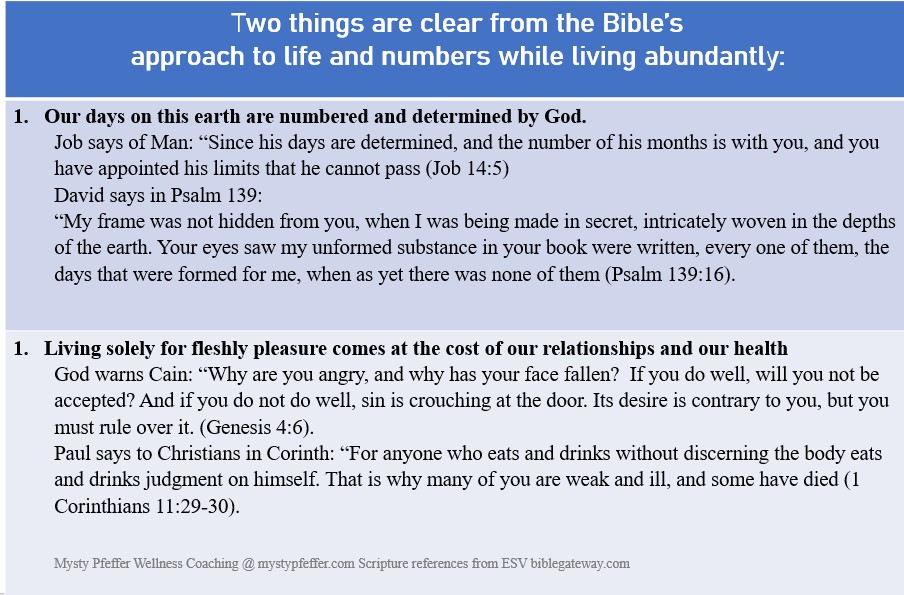
Never Give Up Hope as We Number the Days of Debilitating Behavior.
Week five’s STRENGTH Approach to Christian Wellness theme is one of hope. It is also one of setting a date to release desires for worldly things to God.
Let’s face it, we are focused on numbers. It doesn’t matter if the number relates to our bank account, retirement plan, grocery bill, or the number on a scale, our minds associate success with numbers.
They are also important for helping people control their blood pressure and blood sugar. Numbers on lab results identify problems inhibiting abundant life. Things like chronic kidney disease, heart disease. and autoimmune disease benefit from attention to numbers.
I get it, because I’ve seen the results dash the hopes and livelihoods of hundreds of people over the years! And I don’t want that to be me and you.
Although we cannot prolong our lives any longer than they were determined by God, we can choose items that give us live life to the fullest.
A circumstance Jesus wants for us (John 10:10). Adjusting our attitude towards others in love is a start. Reducing chronic pain with fruits and vegetables, and not relying on processed food is another.
We have the scientific research at our fingertips on how we view life and what we eat affects us mentally and physically.
Scientific Facts
“The new field of nutritional psychiatry provides evidence for diet quality as a modifiable risk factor for mental illnesses.” (1)
“Meta-analyses of observational studies have shown that a healthy diet and Mediterranean diet are associated with lower risk of depression. People with mental illness have been identified as having poorer diet and other lifestyle behaviors that impact health, and less understanding of the impact of lifestyle behaviors on health (2)
Refined sugar and white flour carbohydrates increase chances for heart disease while whole grain, high fiber foods are protective. Saturated fat is not the cause after all (3).
Individuals with a stronger network have better heart health, neurological, endocrine, and immune function than less supported individuals, thus lowering disease risks and extending long-term health. (4)
We are Better Together and Embracing God’s Plan in the Garden
Moreover, consuming more whole grains, beans, and eating less meat; will provide substantial protein and fiber to remove toxins from the body. The toxins create free radicals that are damaging to cells and contribute to disease, anxiety, and pain. The results of which alter mental stability, and lab values.
Heads up! Something is wrong when our culture accepts altered food bathed in unrecognizable preservatives as nurturing to our bodies! We also fall for the lure and lies of material possessions for satisfaction.
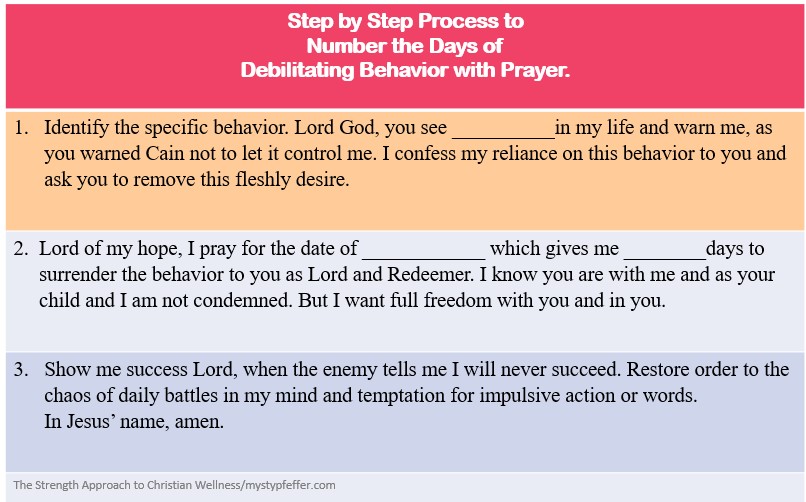
Therefore, numbering the days of reliance on comfort food, material items, gossip, getting even, or whatever is hindering vitality and life will bring new life to the hope within.
More importantly, don’t let lasting change intimidate you. It may mean taking baby steps to get where you want to be and not changing everything at once. I can help you with this in individual Wellness Coaching, since I’ve seen it multiple times and battle it myself.
A point of hope to remember is King Hezekiah. When he was sick and dying, he pleaded with the Lord and the Lord gave him fifteen more years (2 Kings 20). I imagine as the leader of a nation; he had a great deal of stress and his own struggles with lifestyle choices.
However, Hezekiah’s feeling of hopelessness brought him to complete surrender. The same place repeated failures bring you and me. But glory to God! His plea to God brought him through, and it will bring you and I through times of difficult change too.
Remember, God is faithful, and He gives us the strength. His love enables us to bear all things, believe all things, hope all things, and endure all things (1 Corinthians 13:7). I am with you too and will pray for you! Just leave me a comment or contact me for a free consult.
Marx, W., Moseley, G., Berk, M., & Jacka, F. (2017). Nutritional psychiatry: The present state of the evidence. Proceedings of the Nutrition Society, 76(4), 427-436. doi:10.1017/S0029665117002026
Natalie Parletta, Dorota Zarnowiecki, Jihyun Cho, Amy Wilson, Svetlana Bogomolova, Anthony Villani, Catherine Itsiopoulos, Theo Niyonsenga, Sarah Blunden, Barbara Meyer, Leonie Segal, Bernhard T. Baune & Kerin O’Dea (2019) A Mediterranean-style dietary intervention supplemented with fish oil improves diet quality and mental health in people with depression: A randomized controlled trial (HELFIMED), Nutritional Neuroscience, 22:7, 474-487, DOI: 10.1080/1028415X.2017.1411320
Shrout, Rose M. Department of Human Development and Family Studies, Purdue University, West Lafayette, IN, 47907, USA b Center on Aging and the Life Course, Purdue University, West Lafayette, IN, 47907, USA Received 12 May 2021, Revised 3 August 2021, Accepted 9 August 2021, Available online 13 August 2021, Version of Record 24 August 2021.
E= Engage Others for Support
Time is moving on! It’s already week four of the Strength Approach to Christian Wellness. I pray these last three weeks of strategies will help you establish lasting change. Today’s strategy is E=Engage Others for Support.
Now, the last thing you and I want to do is engage lightly. It is not a flippant effort to get someone else involved in what we are doing. Rather, it involves establishing a meaningful contact or connection. Because, my friend, we cannot do the most challenging things alone.
Take the engagement of Mary to Joseph, for example. The betrothal agreement at that time was in essence a marriage; however, it occurs prior to living together and consummating the marriage. Timothy S. Lane and Paul David Tripp in their book, How People Change point out the many instances in the bible where we, as Christ followers, are married to Christ.
Lane and Tripp ask, “What does it mean to be married to Christ?” Jesus loves us so much he died for us, so his affection in bringing us into relationship with Him is evident. When we are “married” to Christ, we honor him with our attention, our bodies, our consumption of goods, and even our attitudes.
But do we truly honor this engagement? How do we place things, people, food, jobs, success, or money ahead of Him? Lane and Tripp say in their book we are enticed by comfort and after a hard day we think we deserve it. This quote in their book really resonated with me:
“Comfort and leisure are good things, but when my personal comfort becomes more to me than Christ, it impacts my behavior sinfully.”
Tripp & Lane
It sure does! That’s why I need to engage others for support. Honest, bible-believing friends and family are needed who not only encourage me, but hold me accountable for my actions.
Because, my friend, we cannot do the most challenging things alone. Loved ones may not understand at first the desire for new habits. However, earnestly enlisting their attention and support helps the process.
Think about how many times you’ve started a lifestyle habit and someone close to you unwittingly tempts you to take three steps back.
Maybe well-meaning family and friends like us just the way we are. Or they may begin to feel a little insecure if we change too much. They like comfort and leisure as much as we do! Regardless of their reasons, our loved ones need to understand why our efforts and intentions for a better life are so important.
Sincere conversations with those we love engages them in the change process. When we share the heavy burden of discontentment with the way we are now, they truly understand why we need their support. Especially if the lifestyle change is avoiding certain establishments, vulgar language, violent movies, or bringing tempting items into the house.
Engaging Others for Support, Step by Step
Once the burden in shared, boundaries can be set in place to avoid temping, cajoling, or creation of circumstances to sabotage our efforts. Whether, the focus of our goal is to improve health, relationship, or reduce anxiety, asking for support is acceptable. Here is what this looks like in action:
Share your deepest desire to change with your trusted friend or loved one.
Tell them what areas you need help in the most.
Ask them to pray with you and for you every day of your challenge.
Let them know ahead of time what activities you will not be participating in as you establish new habits.
Together, discover new areas of entertainment or activities that are equally enjoyable and place Christ first in our hearts.
Consider the following scriptures:
“Because there is one bread, we who are many are one body, for we all partake of the one bread. 1
Corinthians 10:17
“Let no one seek his own good, but the good of his neighbor.”
1 Corinthians 10:24
“For just as the body is one and has many members, and all the members of the body, though many, are one body, so it is with Christ. For in one Spirit, we were all baptized into one body—Jews or Greeks, slaves or free—and all were made to drink of one Spirit. If one member suffers, all suffer together; if one member is honored, all rejoice together.”
1 Corinthians 12:12,13,26
Change is a battle of our flesh against the temptations of the world and God’s will for us. He wants us to have Shalom–wholeness, harmony, delight, and flourishing (1). But our flesh longs for things not created or designed by God to allow Shalom to take place.
So, as you and I engage in this battle to improve our lives with sustainable lifestyle changes, we can call on friends, loved ones, and the body of Christ to encourage us along the way.
I am here with you and rooting for you!
References:
Lane, Timothy S. Tripp, Paul David 2019. How People Change, New Growth Press, Greensboro 27404
McLelland, Kristi, 2019, Jesus and Women In the First Century and Now, Lifeway Publishing, One Lifeway Plaza, Nashville, TN 37234
R= Receive the Benefits of God’s Provision
Welcome to week three of the STRENGTH approach to Christian Wellness. In week one I covered S= Strategies for lasting change and in week two T=Tastes that Satisfy. Today is R= Receive benefits of God’s provision in scripture and the garden. I pray you and I are ready to dive in and receive what God has for us today!
When we are in a posture to accept such a gift, we get a deeper appreciation of all power and authority belonging to God. He spoke the plants into being and gave them the ability to restore and repair cells. Our thoughtful, loving Creator knew what you and I would need before we came to be.
Let His kindness and care wash over you a few minutes.
Who loves you so much, that every need your physical body requires to function is placed at your fingertips? God does. He said,
“Behold, I have given you every plant yielding seed that is on the face of all the earth, and every tree with seed in its fruit. You shall have them for food.”
However, God’s presence among us is even more impressive! Our souls long for Him and He is there. Opening the bible daily with intention, gives us all of Him. It is the living Word (Hebrews 4:12) capable of filling us with encouragement, wisdom, love, and strength.
The Lord is my strength and my shield; in him my heart trusts, and I am helped; my heart exults, and with my song I give thanks to him.
Psalm 28:7
He is our strength, and apart from Him we can do nothing (John 15:5) However, to receive what God has to offer, we must ask.
Jesus said, “Therefore, I tell you, whatever you ask in prayer, believe that you have received it, and it will be yours.
Is it a desire for more of Him and less of the world? It is less instant gratification ruling choices more than the Creator? Maybe it’s freedom from daily choices hindering lasting joy or fruit of the Christian faith? The fruit of the Spirit like love, joy, peace, patience, kindness, goodness, gentleness, faithfulness, and self-control (Gal 5:22).
The context of Mathew 11:24 shows Jesus and the disciples approaching a fig tree the day before and not finding any fruit on it for them to eat. Jesus said, “May no one ever eat fruit from you again.” The physical meets the spiritual as he moves on to Jerusalem and overturns the money-changers’ tables in His Father’s house. The house of prayer had been turned into a market place. The hearts of those in attendance, were far removed from the Lord and focused on their immediate needs.
The next day, the disciples witnessed the withered fig tree and Peter says, “Rabbi look! The fig tree you cursed has withered. Jesus answers, “Have faith in God. Truly, I say to you, whoever says to this mountain, ‘Be taken up and thrown into the sea’ and does not doubt in his heart, but believes that what he says will come to pass, it will be done for him.”
What is the spiritual or emotional mountain that you and I need to receive peace from today?
If we are feeling withered and drained of energy, focus, and excitement, we can pray to receive it today! God is faithful to the heart that believes He is capable. I believe, we’ll both find that he is willing to remove it from us and give us a contentment we’ve never known before.
In addition, benefits of receiving God’s Word, is how it renews our minds. We confess to the Lord Jesus Christ any emotion, addiction, areas of unbelief, or disregard for His provision in prayer. The mountain of guilt and shame we experience with every failure and weakness is lain at His feet.
Moreover, we have new eyes to receive God’s provision in scripture and the garden as compared to what the world offers. As the fleeting pleasures of the world fail to meet the deepest needs of our soul, the desire to give in to them will depart.
“But put on the Lord Jesus Christ, and make no provision for the flesh, to gratify its desires.” Romans 13:14
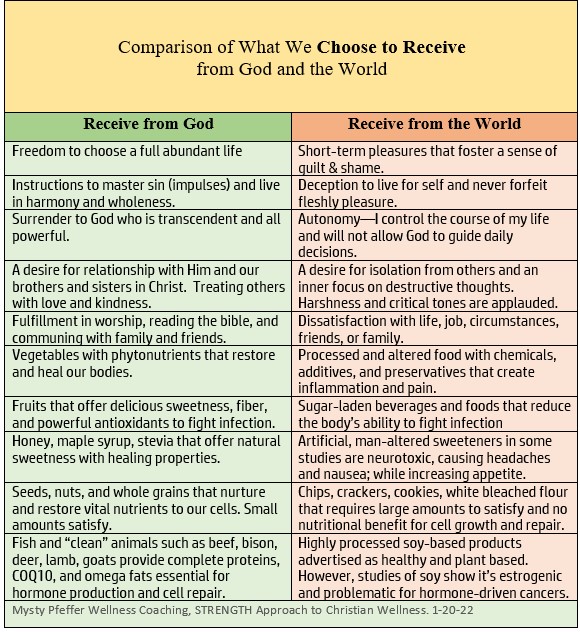
The table below shows a comparison of what we choose to receive from God and the scriptures and what we choose to receive from the world.
What we receive from God and the world.
The bottom line is YOU and I matter to God.
Therefore, the daily choices we make matter to God, too. Our attitude, speech, tone of voice, how we treat one another and ourselves scream to the world where we stand in our faith. The food choices we make also reveal little appreciation for physical wellness.
But is does not have to be that way!
The hard truth you and I face daily in the mirror is we cannot do it alone. When we willfully seek the things of the flesh, and turn to receive things of the world to satisfy needs, we look just like the unbelievers around us. The message sent to our Father in heaven, and the world is, “I know best”.
Furthermore, the serpent’s lie to Eve in the garden is still alive and thriving today. But God is not holding out on us! He sternly warned her son Cain to be cautious about his attitude and actions. I understand it as a warning for me and what I choose to receive as well.:
“…because sin is crouching at the door and it desires to have you, but you must rule over it.” Genesis 4:7b New International Version
Three questions I’d like you and I to ponder this week and pray about are:
How much am I like Eve and Cain in choosing to receive what the world offers?
What part of this world holds such vast joy that I choose to receive it over God’s provision in scripture and the garden?
What mountain of habitual behavior (or sin) below inhibits me from living in full joy and what would it feel like to have victory over it for good?
pride
boasting
shame
guilt
judgement
coveting
alcoholism
fear
jealousy
greed
gluttony
loneliness
hatred/anger
insecurity
smoking
anxiety
envy
rejection
laziness
gossip
materialism
vanity
sadness
lust
idolatry
poor coping
food addiction
disrespect
fighting
stress
apathy
discontentment
selfishness
self-harm
destructive thoughts
disbelief
lack of faith
distrust
pain
Please know, I need this series as much as you do! I am praying for you and learning alongside you as I study God’s life-changing Word. May we both receive the benefits of God’s provision in scripture and the garden each day to live full lives!
Prayer:
God in heaven, you are holy, mighty, generous, and merciful! Your abundant provision in scripture and the garden are powerful to restore my mind and body. I need more of both, Lord, each day. Therefore, I confess my weakness of flesh, and my desire to please the flesh. May the harmful choices I receive from the world become repulsive. Please take away the guilt and shame and renew my mind. I want to walk completely with you, mind, body, and spirit. I want to fully function in peace and harmony that only comes with your instruction. In you, there is a contentment that surpasses all understanding, I ask, and I believe I will receive all of you today. In Jesus’ name I pray, amen.
T= Tastes that Satisfy
Week 2 of Strategies for Lasting Change
Tastes are powerful motivators and distractors! Did you know our taste buds replenish themselves every ten to twelve days? (1) New cells can develop new tastes that satisfy as we begin to learn the value of intentional eating and why God’s Garden is so Good.
More importantly, tasting the Word of the Lord has more value and purpose than what He placed in the garden. King David, the Psalmist reminds us:
Oh, taste and see that the Lord is good! Blessed is the man who takes refuge in him! Psalm 34:8
We develop a taste for physical foods when we are in our mother’s womb. Shortly thereafter, as we develop and grow, we learn about tastes of a spiritual sense.
For instance, a fetus develops taste buds in her mother at around 10-13 weeks’ gestation. (2) Food flavors are transferred to the fetus through the continuous swallowing of amniotic fluid in the womb. Whatever the mother eats consistently throughout her pregnancy, is present for her child’s future preferences.
We all have favorite tastes. Some prefer the dark, rich, brew of morning coffee while others a fresh cup of juice. We consume salty chips with relish or a mouth-watering chocolate brownie fix with delight. The palate preferences of bitter, salty, and sweet all evoke emotions and satisfy.
However, the one thing they all have in common… taste is fleeting.
It’s here one moment and in the belly the next. There is no lingering contentment, just desire for more. Furthermore, our memory of it creates mouth-watering anticipation when our eyes see the favored morsel again.
On the other hand, the idea of tasting the “heavenly gift” and the “goodness of God’s word” is far superior to any earthly item we consume (Hebrews 6:4-5). It provides lingering contentment for our souls. When we are transformed by the power of the Holy Spirit, we crave and savor God’s word more than our favorite meal.
Therefore, strategies for lasting change in tastes that satisfy begin with these simple steps:
Appreciate the flavors you are experiencing by slowing down the chewing process to 20 -30 seconds. Savor your favorite taste slowly and leisurely. Jean Kristellar, PhD., developed a Mindfulness Eating Program to help people with eating disorders. She suggests to be aware of all the flavors in the food, as well as the feelings associated with hunger and fullness. The more aware a person is of those true hunger pains and fullness, the less likely he is to overeat.
Research shows the first two bites of food a person eats are the most pleasurable, then taste sensation diminishes. So, a technique suggested in Kristellar’s program is to pick a favorite snack and make the first two bites last in your mouth a whole minute. One square of chocolate, for instance, may be enough to meet the pleasure spot on the pallet rather than an entire candy bar loaded with sugar and calories.
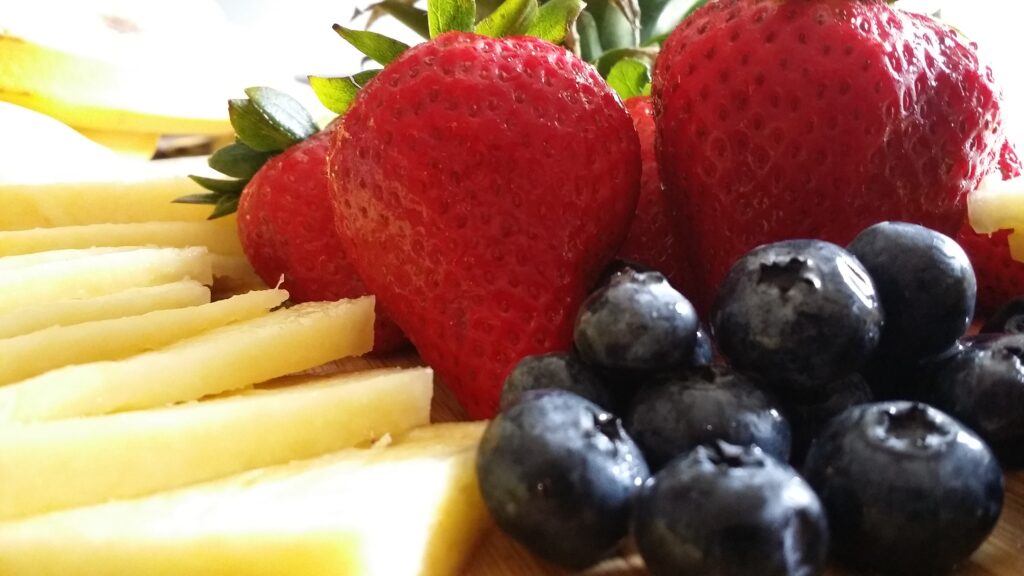
Replace sugar-loaded sides as the main meal or desserts with fresh fruit. Whole fruits, rather than fruit juice, provides nutrients and fiber alongside their natural sweetness. If the fresh fruit is chosen as dessert the meal itself will have plenty of protein to avoid sugar spikes and lows.
However, if it replaces a sugary breakfast choice, add a couple of walnuts or almonds for protein. An example of this is peanut butter on an organic apple for breakfast or kiwi and plain yogurt with walnuts. The quality nutrients in this choice will give us more energy, and a sense of fullness throughout the morning.
Spelt & Walnut Breakfast Bowl.
Yogurt & Chia Seed Fruit Bowl
Doughnuts and sugar-laden cereals have next to zero nutritional value for children and adults. Making them a part of everyday life damages the body’s cells and leaves them hungry for real food. Nutrient depleted items like these were not on our Creator’s mind when He made us.
Give Vegetables Another Chance
Intentional eating approaches vegetables with a new mindset. It means changing the focus from an experience of “How will this make me feel?” to “How will this nourish me to do God’s work?” The more one understands the benefits of vitamins, minerals, and antioxidants in food, the more value it holds. The nutrients available supply added energy, stamina, and vitality. All important factors in living an abundant life and fulfilling our calling.
“When I was a child, I spoke like a child, I thought like a child, I reasoned like a child. When I became a man, I gave up childish ways.” 1 Corinthians 13:11
Although some people are reluctant to consume vegetables, it is a good idea to give them another try. Tastes and values change as we age and it takes several tries of various plants to develop a desire for them. Also, when tastes are accustomed to high amounts of sodium and sugar in processed food, the taste buds are trained and expect more of the same substances.
Retraining the taste buds can happen though, with good seasoning and highly fragrant spices.
Snap Peas & Kale
Cauliflower & Asparagus Medley
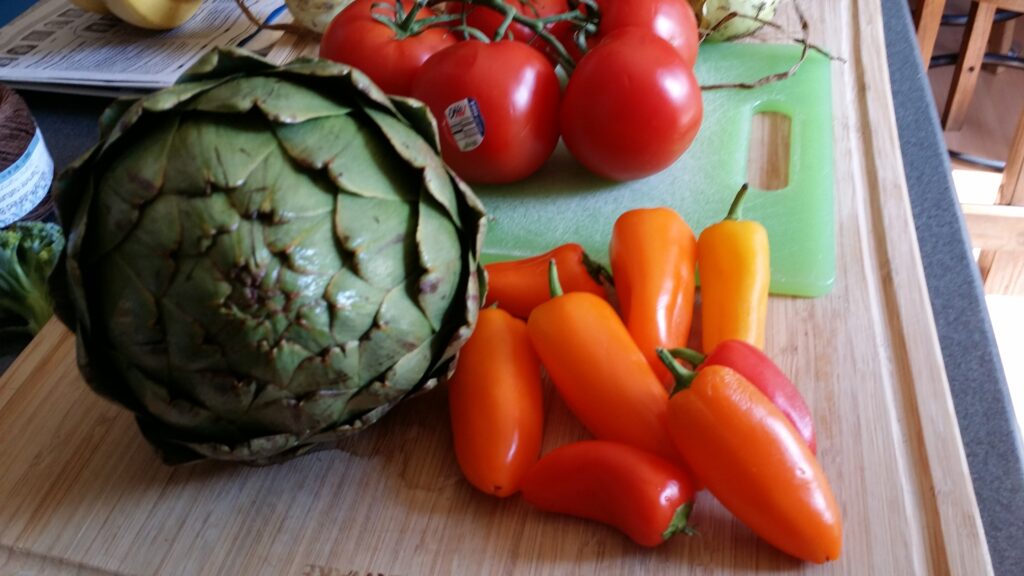
Artichoke
Fasting From Processed Food with Prayer
Removing processed food from the pallet for four weeks will diminish the desire. I know, who does that now days? We as Christ-followers, that’s who. A fast of this nature can be done with prayer and scripture memorization.
Jesus said, “It is written “‘Man shall not live by bread alone, but by every word that comes from the mouth of God” Mathew 4:4
He also said:
Jesus said to them, “I am the bread of life; whoever comes to me shall not hunger, and whoever believes in me shall never thirst. John 6:35
The goal is to look beyond food for emotional satisfaction and think logically about what you and me, as Christians, consume each day. Do we live as though every day is a feast day? Or, do we practice restraint when we sit down for a meal? “Are you and I eating mindlessly and not chewing slowly and savoring each bite with gratitude? I must admit, I am guilty of this more than I care to admit.
Eat Less Often and Smaller Amounts
People in Jesus’ day walked everywhere and ate what was available fresh. They ate fresh milled bread, curds, cheese, fish, fruits, and vegetables (Gen 18:8, Deut. 32:14, Gen 1:29, 1 Sam 17:18, 2 Samuel 17:29, Daniel 1:12-16 ESV) We have an idea of how much was acceptable to eat daily from the amount of manna the Israelites collected in the wilderness. The dry measure of one omer was about 3.7 quarts of bread per day for the entire family (Exodus 16:16).
A Simple strategy to implement as we follow their lead is to stop eating between meals and after dinner at night. Another is to remember the size of our stomach is roughly the size of our hand and using a plate that size helps us with portion control. Although the stomach’s stretching capacity is 40 times that size, Hiatal hernias and reflux disease are common among those who practice testing its limits.
Eating items rich in fiber, protein and nutrients may not only help us feel full, but remove cravings. Drinking water to offset false hunger is helpful alongside the first step of eating slowly during our meals and recognizing when we are truly hungry and full.
I hope with prayer and gratitude towards God and His provision, we will truly appreciate tastes that satisfy. More importantly, may we learn to rely on the goodness of His Word as the taste that truly satisfies! I am confident the strategies for lasting change can be done when our focus is off ourselves and on God.
Don’t forget, I am on this journey with you and I am here for you!
AlJulaih GH, Lasrado S. Anatomy, Head and Neck, Tongue Taste Buds. [Updated 2021 Aug 11]. In: StatPearls [Internet]. Treasure Island (FL): StatPearls Publishing; 2022 Jan-. Available from: https://www.ncbi.nlm.nih.gov/books/NBK539696/
By Amy Novotney, November 2012, Vol 43, No. 10 Print version: page 42
Intentional Eating
Intentional Eating Series 1
Intentional eating begins with a new mindset. If I can clearly see a plan set before me to thrive, I want to be a part of it and share it with you. God’s plan from the third day in the garden is exactly where that begins. Mindsets change from what is pleasing to the flesh and become what is pleasing to God when you and I follow his plan.
He is pleased when we obey Him. I believe it’s just like when I am pleased my grandkids don’t run out into the street when a car comes. Preventing our hurt saves Him hurt.
Jesus said, “If you love me, you will keep my commandments. And I will ask the Father, and he will give you another Helper, to be with you forever”
Although we are sometimes taught to think of everything he said in spiritual terms, he put the spirit in a body, with a mind, that makes decisions every day. It’s easy to play the Pharisee in terms of other sins against the body than the one I am most guilty of…food.
You know, those certain items in the daily routine that have no nutritional value and are loaded with preservatives that are damaging to the cells. The “Frankenfoods” that are more than a habit, they’re must haves. When there is physical withdrawal from them or when my mouth waters at the site and smell of them, I might have an idol.
It may be easy for some people to deny food as an idol, but I’d like to see them give up their favorites to fast and pray so they see what happens. When you and I are intentional about eating what God provides in the garden, we are less prone to food idolatry and chronic disease. My friend, obeying God’s plan this way means less suffering for us, which is pleasing to God!
“I see a day not long from now when every major mainstream media outlet proclaims this headline: Christians are the world’s healthiest people, with less heart disease, diabetes and obesity than the rest of the world and have a vibrant level of health”
Jordan S. Rubin
Can you see that day coming too?
I can, and it is my passion for the body of Christ. I have spent half of my life caring for, teaching, and comforting families of the sick and dying as a registered nurse. When I look at God’s plan unfold in the bible, I long for my brothers and siters to grasp the abundant life God calls them to live.
His plan is for our good and prosperous health! Not only that, but he provides everything we need to maintain and sustain the bodies he gave us to house the Holy Spirit.
I found the quote from Rubin, in the foreword of a book I just finished by Dr. Rex Russell, “What the Bible Says About Healthy Living. Dr. Russell’s three principles are easy to follow and very rewarding.
Eat the Foods God Created for you
Don’t Alter God’s Design
Don’t let Any Food or Drink Become Your God “( 1996)
Intentionally incorporating this way of eating every day will change our minds about the choices we make each day. I don’t know about you but I’m tired of battling repeated sinus infections, colds, GERD, and arthritis pain! Changing my eating healed my irritable bowel syndrome years ago, it can help with these problems too.
Even though I eat healthy; practicing 80 percent whole plant based, clean meat items, and 20% junk, I still suffer. I’m ready to start a new plan, God’s plan, with a new mindset. I will be sharing what I learn in Dr. Russell’s book and others in an upcoming workshop an on the Strengthen Your Heart blog with the STRENTH approach to wellness.
Russell, Rex, M.D. 1996, “What the Bible Says About Healthy Living” Baker Publishing Group, P.O. Box 6287, Grand Rapids, MI 49516-6287
S=Strategies for Lasting Change
Welcome to week one of the STRENTH Approach to Christian Wellness. This week I will share with you my favorite way to combat the enemy of fear, doubt, shame, pride, and illness! I don’t say that lightly, it is a daily battle! I believe the victory starts with the S in STRENGTH, S=Strategies for Lasting Change.
Strategies for lasting change begin with small steps that lead to big changes.
The first strategy is to pray for more of God and less of self. A focus on self will always find discontent because it is on wants instead of needs. The focus is on the thoughts and desires of the world and not God.
Second, pray about what God is calling you and me to change in our lives. It may be in an area of relationship, health, addiction, anxiety, or lifestyle choices. The change you and I decide to make may improve how we function in our home, workplace, social gatherings, or church.
Since we are three-part beings; mind, body, and spirit, everything around us and what we put in us matters! Just living through the past two years of 2020 and 2021 has impacted our mental and physical stability. We can’t escape the enticement to fear/anger/anxiety in a toxic culture, but we can create strategies for change that help us cope more effectively and last a lifetime.
Reacting in anger, distancing ourselves from others, reaching for substances or food to find comfort are all vices we reach for to help control emotions.
Whatever the personal struggle giving us some form of comfort, even when we know it’s not healthy; we can name it. And pray for God to place it beneath Him in our desires. We can be sure, we are not alone in our struggle; He loves us and wants us to succeed.
“For I’m sure that neither death nor life, nor angels nor rulers, nor things present not things to come, nor powers, nor height nor depth, nor anything else in all creation, will be able to separate us from the love of God in Christ Jesus our Lord.”
Romans 8:38-39 ESV
Moreover, if we are a people struggling with deteriorating health or battling emotional overeating, poor quality food choices, inactivity, or lack of knowledge; this is a safe place to confront destructive behavior and explore new options. We can connect for a free 30-minute consultation any time. All without judgement or condemnation.
Although, we may want more energy, feel calmer, live healthier, and think more clearly, there is comfort in settling where we are. Using tools like the “wheel of life survey” helps clarify areas of potential dissatisfaction. The Values in Action survey determine ingrained strength to lean into as we approach the change process.
Once God reveals the area of discontent, we can pray about removing obstacles, habits, or desires that conflict with his divine plan for our well-being.
Remember, change begins when we want something better.
Strategies for Lasting Change
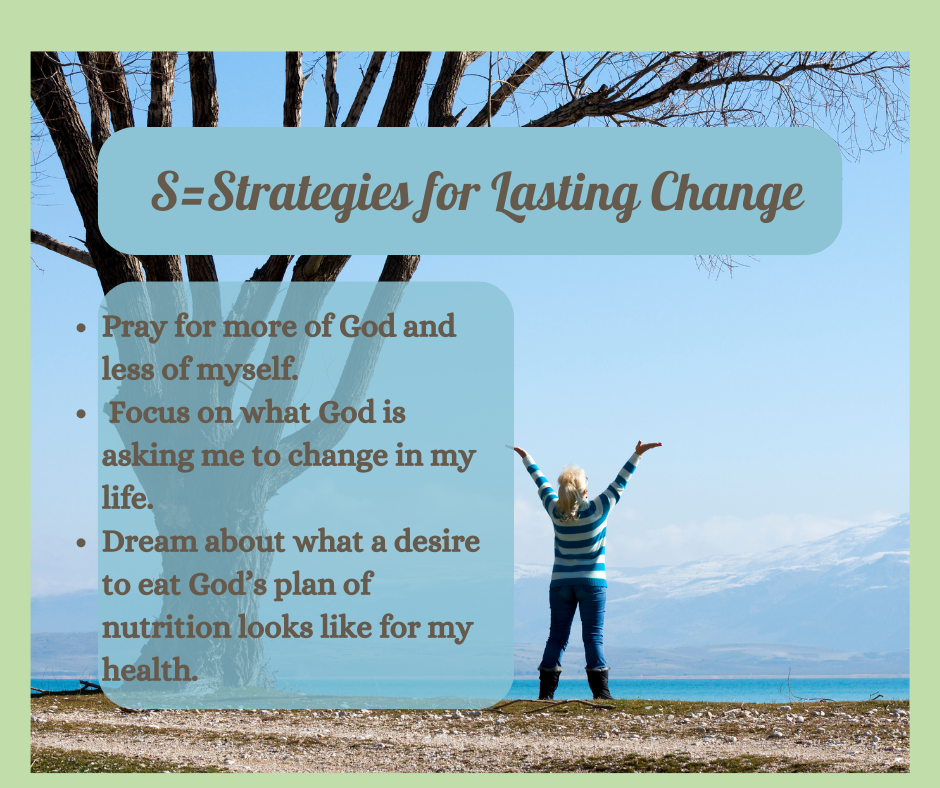
Pray for more of God and less of self.
Pray about what God is asking me to change in my life.
Pray for a desire to eat God’s plan of nutrition designed the 3rd day in the garden to restore, sustain, and heal the mind and body. We have been deceived! There are so many substances in processed food that interfere with brain function! Look at this quote from a PubMed article:
“The most frequently encountered food excitotoxin is glutamate (Glu) which is commercially added to many foods despite evidence that it can freely penetrate certain brain regions and rapidly destroy neurons by hyperactivating the NMDA subtype of Glu receptor. “
NMDA (N -methyl-D-aspartate receptor) in the brain is affected by MSG monosodium glutamate is many processed foods. Kicking it out of our systems and replacing it with natural food from God’s Garden sets us on a path to healing.
Pray for Him to remove the desire for highly processed food with additives, preservatives, and chemicals that are harmful to the cells. Reach instead for foods that coat and protect the brain cells and calm the nerves.
Pray for him to remove fear, anxiety, or anger that is destroying our relationships. Trust and believe that God will give us more of Him and less of the world. Its empty promises are no match for the abundant life we find in our Creator!
Prayer for Lasting Change
The strategies for lasting change my friend, begin with prayer. Seeking God in all we do gives us more strength because He IS our strength. I am here with you and for you, and will be happy to pray for you as you enter this phase of change.
Prayer:
Father God, I come to you humble, bare, and stripped of all barriers blocking my submission to your plan and your ways. Spiritually and physically, I need you now more than ever. I see your power and loving plan for me and others in creation. For your invisible attributes, namely your eternal power and divine nature have been clearly perceived ever since the creation of the world (Romans 1:19) and more recently in the microscopic evidence of your plants. How glorious and wonderful you are, my God and Savior! May I understand today that although all things are lawful, not all things are beneficial or build me up (1 Cor. 10:23). It’s a hard truth, but for anyone who eats and drinks without discerning the body eats and drinks judgment on himself (1 Cor. 11:29) Help me learn a better way! Please help me see the damage of chemicals in food that are making me sick and change my desire for them to foul and disgusting! I cannot do it on my own, I need you, Holy Spirt to guide me in each moment of weakness. I thank you for the victory today, Lord; for it is yours and yours alone! In Jesus’ name I pray, amen.
References:
Olney JW. Excitotoxins in foods. Neurotoxicology. 1994 Fall;15(3):535-44. PMID: 7854587.